
It is the first question almost everyone asks about a used compact tractor, and it is the wrong question to ask first.
The hour meter tells you how long a tractor has run. It does not tell you how hard. Two tractors with the same number on the meter can be in completely different condition, and the difference is the kind of work behind those hours and how well the machine was maintained.
Why the meter alone misleads
An hour of finish mowing and an hour of moving gravel with the loader are recorded the same way. They are not the same wear.
A tractor that spent its life mowing a large lawn has worked its PTO and not much else. A tractor that spent the same hours doing loader and grapple work has put real strain on the front axle, the loader pins, and the hydraulics.
Idle time counts too. A tractor left running while someone opened gates and talked with the neighbors racks up hours without much wear at all.
And meters get replaced. A worn tractor with a low reading is a real possibility, which is why the rest of the machine has to agree with the number.
What the kind of work does
- Heavy loader work wears the front axle, the loader pins and bushings, and the hydraulic system.
- Mowing is comparatively easy. It works the PTO and not a great deal else.
- Ground-engaging work, such as a box blade or tiller, puts steady load on the drivetrain and the three-point hitch.
Ask the seller what the tractor was used for. A plain answer is useful. A vague one tells you something too.
Maintenance records beat the meter
A tractor with more hours and a complete service history is often a better buy than a low-hour tractor with no records at all.
Ask for evidence of regular engine oil changes, hydraulic fluid and filter changes, and greasing. Receipts, a logbook, or dealer service records all count. Hydraulic fluid in particular gets neglected, and it is expensive when it goes wrong.
What to inspect
Bring gloves and plan to spend some time on it.
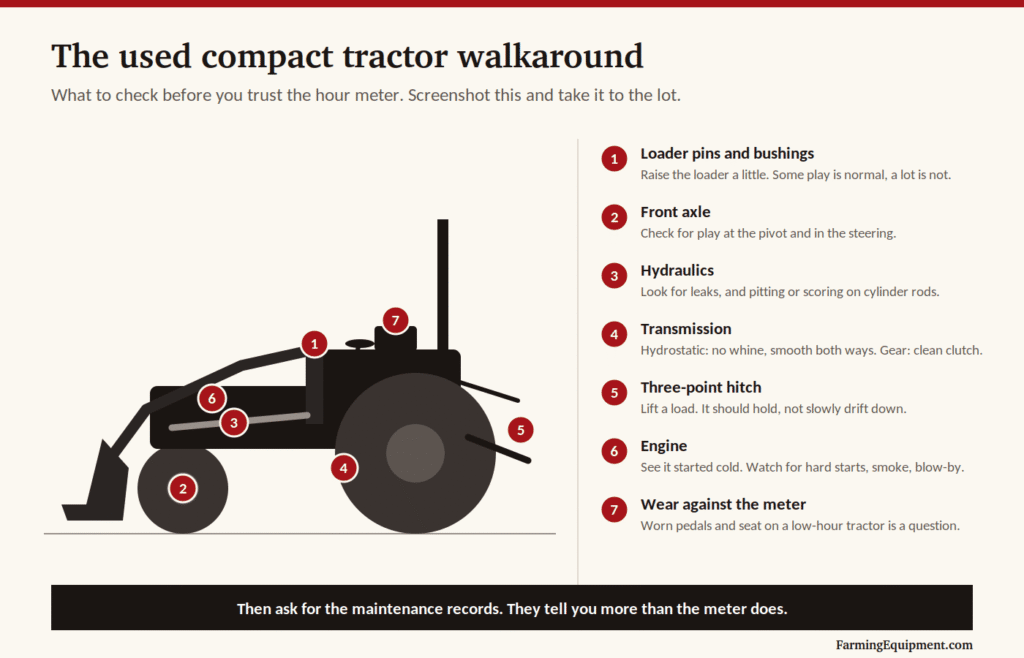
Then check whether the wear matches the meter. Worn pedals, a torn seat, and a smooth steering wheel on a tractor showing very few hours is a question worth asking.
- Loader pins and bushings. With the loader raised a little, look and feel for play at the pivot points. Some movement is normal. A lot is not.
- Front axle. Look for play at the pivot and around the steering components.
- Hydraulics. Check for leaks, and look at the cylinder rods for pitting or scoring.
- Transmission. On a hydrostatic, listen for whining and check that it moves smoothly in both directions. On a gear drive, check that the clutch engages cleanly.
- Three-point hitch. Raise it with a load and see if it holds or slowly drops.
- Engine. Try to see it started cold. Watch for hard starting, heavy smoke, or excessive blow-by.
So how many is too many?
There is no single number. A well-maintained diesel compact tractor can keep working for a long time, and plenty are still earning their keep with several thousand hours on them.
The better question is whether the price reflects the condition. A higher-hour tractor that was cared for, at a fair price, is often the smart buy. A low-hour tractor with no records and signs of hard use is often not.
The bottom line
Use the hour meter as the start of the conversation, not the end of it. Ask what the tractor did, ask for the records, and let the machine itself tell you the rest.