
Every fall, the same conversation happens between farmers and their tax preparers. There is money left in the year, there is a machine that needs replacing, and somebody asks whether buying it now helps at tax time.
A surprising number of people assume the answer only applies to new equipment. It does not. Used equipment qualifies for Section 179, and for a lot of small and mid-size operations, used is where the real buying happens.
This is a plain explanation of how it works. It is general information, not tax advice, and the right answer for your operation depends on your income, your structure, and your preparer.
The short version
- The 2026 limit is $2,560,000. That is the most you can expense under Section 179 in a single tax year.
- The phase-out starts at $4,090,000 in total qualifying purchases. Above that, the limit shrinks dollar for dollar.
- Used equipment qualifies, as long as it is new to you.
- It has to be placed in service by December 31. Bought is not the same as placed in service.
- Business use has to be more than 50 percent.
Both dollar figures come from IRS Revenue Procedure 2025-32. Some websites still show the old limit of $1.25 million, from before Congress raised it in 2025. If you see that number, the page is out of date.
Used equipment qualifies, with one condition
The rule is that the equipment has to be new to you. You cannot have owned or used it before, and you generally cannot buy it from a related party, such as a family member or a business you control, and still take the deduction.
Buying a used tractor from a dealer, at an auction, or from an unrelated neighbor is exactly what the rule was written to allow.
“Placed in service” is the date that matters
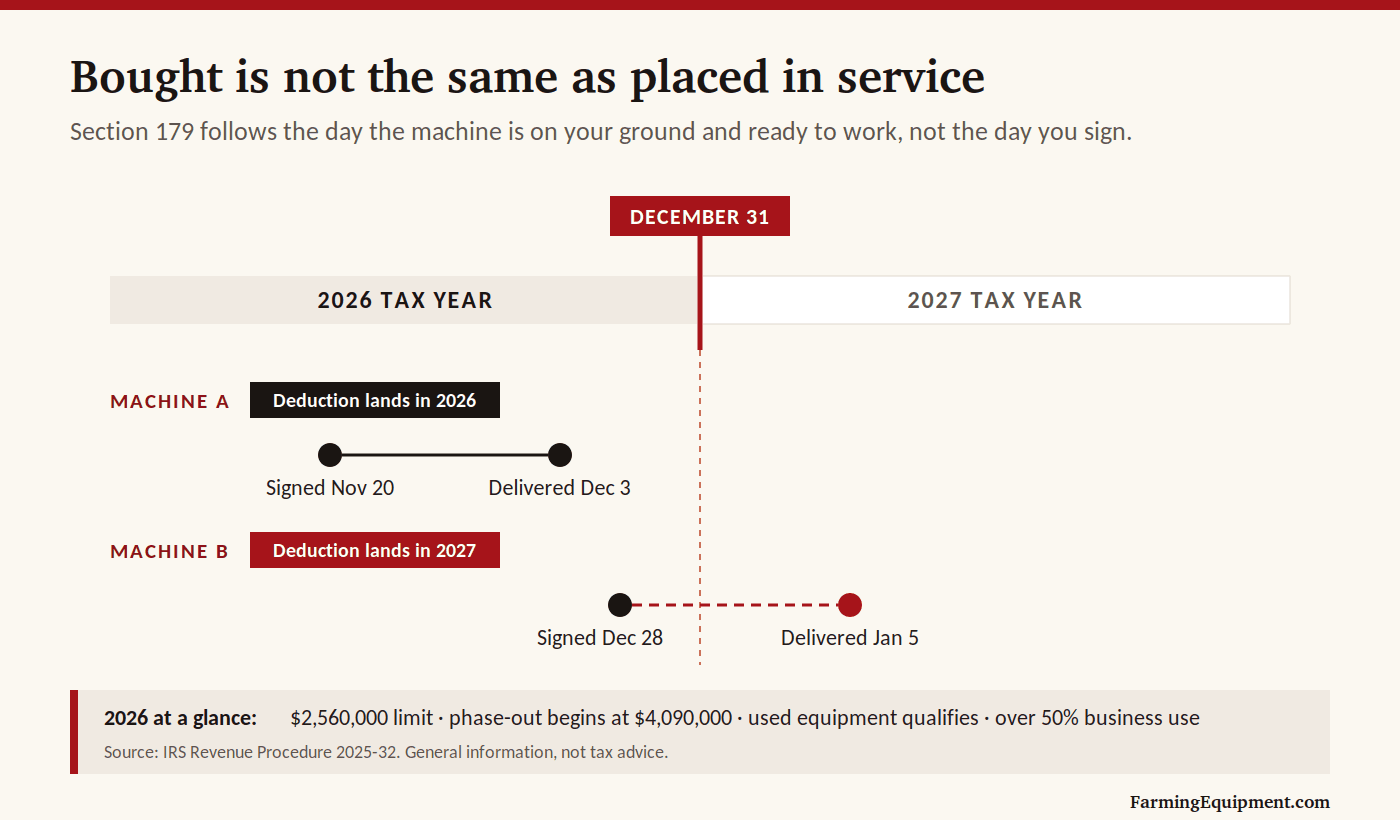
This is the part that catches people. Section 179 applies to equipment placed in service during the tax year, which means it is on your property and ready to do the job it was bought for.
If you sign the paperwork on December 28 and the machine is delivered on January 5, that deduction belongs to next year.
That matters more in the fourth quarter than any other time, because it is when everyone is trying to buy at once. Dealers get busy, transport gets scarce, and late December auction purchases can sit waiting for a truck. If the deduction is part of your reason for buying, get a delivery date in writing and build in some margin.
Financed equipment still qualifies
You do not have to pay cash. Equipment that is financed can still be expensed in full in the year it is placed in service, even though the payments stretch out over several years.
That can be a real advantage, but go in with your eyes open. You get the deduction up front and you are still making payments afterward. Make sure the cash flow works in the years that follow, not just the year of the write-off.
Section 179 or bonus depreciation
There are two main ways to write off equipment quickly, and they behave differently.
Section 179 is limited to your business taxable income. It cannot create a loss. You elect it asset by asset, which gives you control over exactly how much you expense.
Bonus depreciation has no income limit and can create or increase a net operating loss. The 2025 tax law restored 100 percent bonus depreciation for qualifying property acquired after January 19, 2025.
For most small operations the question is not whether you are under the limit, since you almost certainly are. The question is which approach fits your income this year. A year with strong income usually points one way, a thin year another. This is the conversation to have with your preparer before you buy, not after.
The business use test
Equipment has to be used more than 50 percent for business to qualify at all, and the deduction is limited to the business-use percentage.
This matters a lot for smaller acreage. If your place is a business for tax purposes, with real income and a profit motive, these rules apply. If the IRS would see it as a hobby, they generally do not. That line is not always obvious, and it is worth settling with a professional before you count on a deduction.
A worked example
This is illustrative, with round numbers.
A small cattle operation buys a used compact tractor for $38,000 and a used rotary cutter for $4,500. Both are delivered and working by November 15. They are used entirely for the operation, and the business has plenty of taxable income.
The operation can elect to expense the full $42,500 in 2026 instead of depreciating it over several years. The actual tax savings depend on the owner’s bracket, but the deduction lands this year rather than being spread over the next seven.
Before you buy
- Talk to your tax preparer first. The best time to ask is before you sign, not in March.
- Get the delivery date in writing, especially for anything bought in December.
- Keep the invoice and proof of delivery. The delivery date is what establishes when the machine was placed in service.
- Check the date on anything you read online. The limits changed substantially in 2025, and plenty of pages have not caught up.
This article is general information and is not tax advice. Tax rules depend on your circumstances. Consult a qualified tax professional before making purchasing decisions based on tax treatment.